“But I swear he was lame yesterday Doc!” Such are the words often proclaimed by frustrated owners of horses that show non-resolving intermittent lameness. Frequently I am presented with a horse that has had variable amounts of lameness over a course of time with no obvious source of heat, pain or swelling. The horse seems to show improvement with shoeing changes, anti-inflammatory therapy and work changes but in the end still comes up unpredictability lame. When the defining characterization of the lameness is that it is unpredictable, then I place high suspensory ligament injury at the top of my list of suspect causes.
The suspensory ligament is part of the suspensory apparatus. The suspensory apparatus (SA) is shown in the photo as highlighted in color. The red portion is the actual suspensory ligament, the green portion is the abaxial bone(s) and the blue portion highlights the distal sesmoidian ligaments. These three portions of the SA act as a sling to support weight bearing on the bones of the fetlock. During weight bearing, the suspensory ligament actually stretches a bit to provide concussion absorption and energy retention much like a bungee cord. While any portion of the SA can sustain an injury, we are going to discuss injury to the origin (top) of the suspensory ligament just below and behind the knee (carpus) as is indicated by the yellow arrow.
Often with injuries to the origin of the suspensory ligament (high suspensory disease) owners
note:
- consistently inconsistent lameness
- lack of swelling
- lameness worse with leg to outside of circle
- lameness worse while going down hill
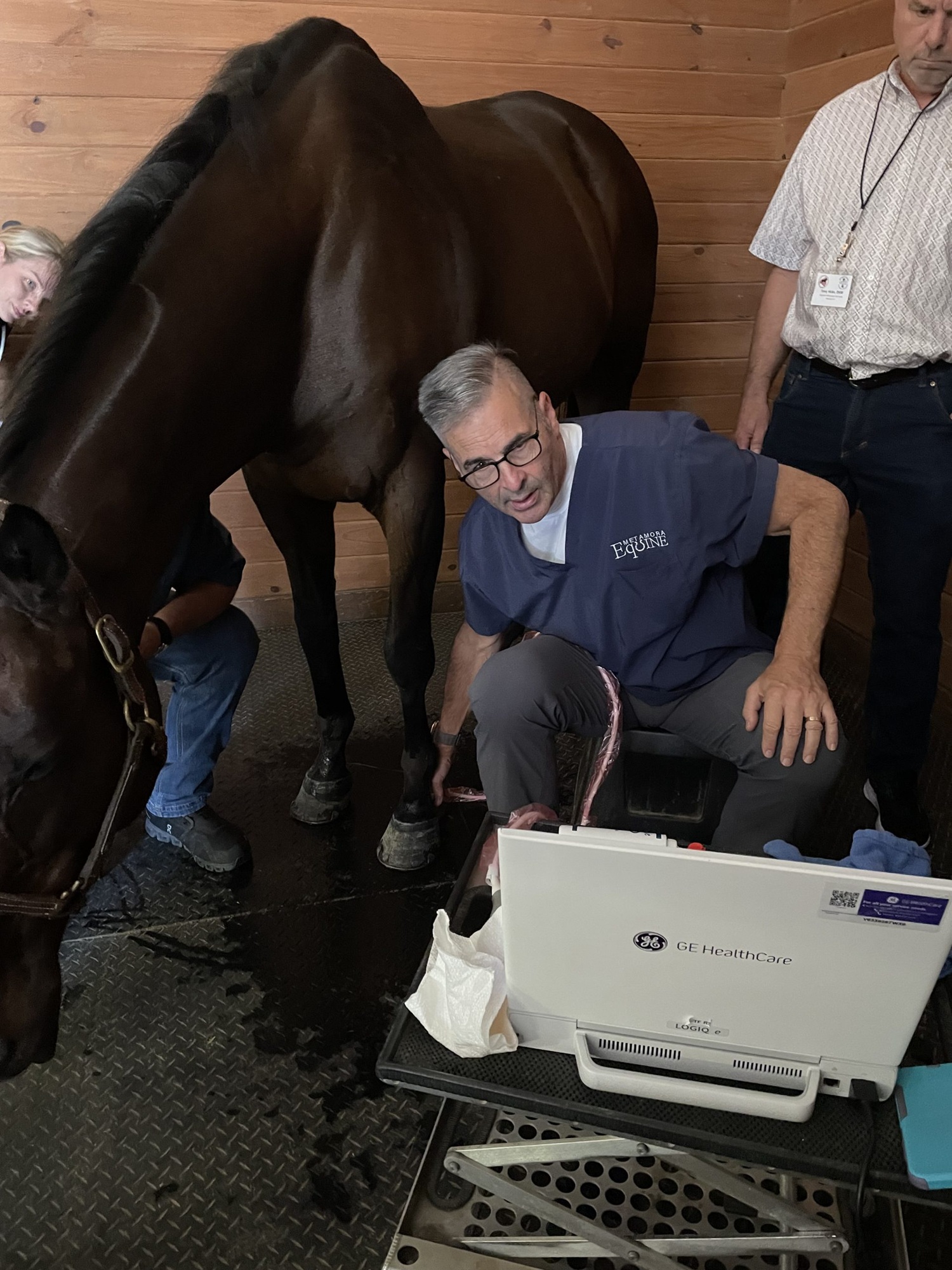
While other injuries can cause similar signs, a non-resolving chronic lameness is a good candidate for diagnostic nerve blocking. Provided the horse can be examined on a day that he/she is lame; diagnostic blocking should start low in the foot and continue up the leg until the lameness resolves to everyone’s satisfaction. The area should then be imaged to determine the severity of damage. Most of the injuries to this area are in the actual ligament fibers and hence an ultrasound can often identify the damaged area. It should be noted that injury can occur in the bone where the fibers attach. These types of boney injuries are best imaged with radiography. |
|
The ultrasound examination should include a comparison of the opposite limb. The origin of the suspensory ligament is not from ligament tissue but rather it is a structure recruited from muscle tissue. During microscopic dissection the different elements within the structure of the “ligament” are clearly visible. With recent upgrades in diagnostic ultrasound capability (harmonic probes and high definition probes) the variation in fiber pattern can often mimic an injury in appearance. This is why it is very important to first block the horse and then to compare the affected ligament with the opposite leg.
Treatment of these injuries is usually successful. The ultrasound examination will give an approximation as to the amount of rest needed. Some horses simply need to go into a progressive work program while others may need nine months off. In addition, other adjunct therapies hold promise. Clinical studies have supported the use of shock wave therapy both in terms of driving non-healing horses into repair and especially in terms of the increased quality of repair. Other therapies that hold promise are Acell therapy and stem cell therapy. In general, it has been my experience that 80% of high suspensory ligament injuries will heal, given the opportunity to do so. With the use of shock wave therapy, almost 95% of the horses will return to soundness.
While shock wave therapy is able to help most of the non-resolving cases, there are specifically difficult situations. First, older horses seem not to respond as well to therapy and in my experience seem prone to re-injury. Second, horses with hind limb high suspensory injuries are often career threatening. While the horse can return to a reasonable degree of athleticism it is often at a lower level than where they were at the time of injury. And finally, horses with progressive chronic dropping of the fetlock are often not responsive to therapy.
If you have a horse with a suspensory ligament injury or if you have questions regarding this article, feel free to contact Roland Thaler VMD at 248.628.5843.
 |